Repeater Host FAQ

1: What will the repeater node be used for?
- It will expand a community oriented, free, open source community mesh network using low power radio
- The mesh enables text-based communication in areas with limited cellular or internet coverage, or to users who can't afford cellular or internet service
- It stays up when power, cellular networks, or the internet goes down, enabling emergency communications and community support
2: What kind of equipment will be installed?
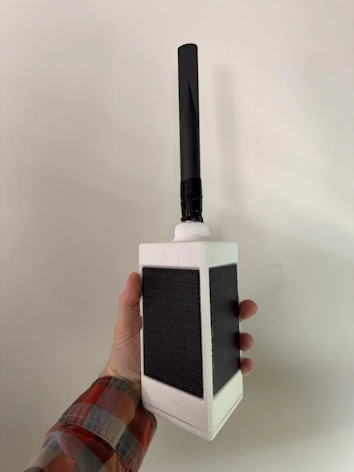
- Normally a small, waterproof box containing a microcontroller and a battery
- A lightweight antenna and a small solar panel or two
- Typically under two pounds, about the size of an internet router with a larger antenna
3: How much power and bandwidth are required?
- None. Nodes are intentionally self sufficient; they are solar powered and do not connect to the internet
4: How will it be installed?
- Installation on structures normally uses magnets on a flat metal surface or u-bolts/hose clamps around a mast or pole.
- Installation in trees normally uses a small rope around a sturdy branch, with the node hanging from below, and a longer rope used to hoist the node in place (like a flagpole).
- No screwing, nailing, drilling, or adhesives are used unless explicitly agreed on beforehand.
- If you have specific requirements, let us know. We can almost always find a way to complete installation without requiring any alteration to your property, provided that the solar panel(s) are exposed to the sun.
- Depending on the circumstance, a cable may be run between the node and the antenna. No cabling will be run into the structure.
5: What is the expected maintenance/access requirement?
- Very low; nodes are designed to run autonomously for long periods
- Occasional visits may be needed for firmware updates or hardware checks/maintenance, typically no more than once or twice a year.
- Access terms can be agreed on and set in writing
6: Will the equipment cause any interference with my existing systems?
- Extremely unlikely; the RDUMesh network operates on different frequencies from Wi-Fi, cellular, or TV systems (specifically the ISM band, 902-928 MHz)
- Transmit power does not exceed 1 watt; typically 0.3-0.6 watts
- Nodes are designed to be non-disruptive and FCC compliant; you can request testing or documentation if concerned
7: What are the security risks for my network/customer data?
- Virtually non-existent; nodes will not connect to your network/wi-fi in any way
- Most nodes do not have wi-fi radios at all; those that do have them disabled except during firmware updates, and they do not connect to other networks for updates. We can accommodate requests for nodes with no wi-fi capabilities if needed
- Nodes typically have low power bluetooth radios, but these are also disabled except during firmware updates
- Nodes do not have cameras or sensors, except for temperature and voltage sensors used to monitor the node's own hardware.
- Nodes do not broadcast their own messages except to advertise their presence or report their temperature or battery level; they only repeat messages from end-user devices.
8: What are the liability implications?
- The property owner carries the liability, although the likelihood of an incident is expected to be minimal
9: Are there any permits, HOA, zoning, or regulatory issues to be aware of?
- Permits are not needed for small antennas or non-commercial installations
- HOA or building rules may restrict roof modifications, even non-permanent ones - check before proceeding
- We recommend getting written permission if you're a tenant or part of a shared property
10: What is the day to day experience like?
- If you choose to use the mesh, you'll benefit from a reliable link to the network
- Otherwise, you'll probably forget that it's there. Nodes are designed to function autonomously for long periods with no in-person interaction and don't need anything other than elevation and sunlight.
11: How long is the node expected to stay there? Can it be removed at any time?
- We will work with you to determine a clear agreement or time frame
- No long-term obligation is required. Ultimately, you may request removal at any time, with coordination and reasonable time allowance for removal
- Removal should not leave any long term marks or damage
Credit to Austin Mesh for much of the formatting and content