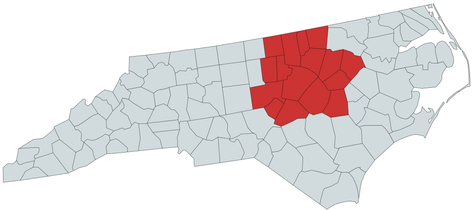
Tarheel Backhaul: How Chapel Hill Joined the Mesh

signal: @santiago.19
discord: @santiago_hotel
Durham, NC | 24 April 2026
There’s a moment in a lot of mutual aid work where something shifts, and if you weren’t there for it, you might never even know it happened.
There’s no announcement, no press release, no clean “before and after.” It’s usually just a handful of people showing up, carrying what they can, figuring it out as they go, and trusting each other enough to try something that isn’t guaranteed to work.
For us, that moment probably started back in January.
Triangle Mutual Aid hosted an open “mesh interest” meeting, and going into it, the expectation was pretty modest — maybe half a dozen people, a few radios on the table, a conversation that might or might not go anywhere. Instead, it was a standing-room only. People packed into the space, not just radio folks, but organizers, community members, people trying to understand what it would mean to have communications that didn’t depend on the same infrastructure we’re all used to relying on.
At that point, I was a MeshCore newb, but something was clearly happening.
After the meeting, I went home, flashed my first node, and within a day or two I had maybe eight contacts, just a short list of names, enough to prove that the thing actually worked. A few months later, that list is maxed out. Same network, same basic idea, but it’s grown into something that feels alive. More nodes, more paths, more reasons to use it, more people taking ownership of it in their own way.
That meeting didn’t just introduce a piece of technology. It introduced a group of people who were willing to build something together.
That’s where I met Magnus, a mesh enthusiast out of Raleigh who had already been putting time into getting things organized locally. He registered rdumesh.org early on, and has been one of several people helping keep things moving, connecting folks, sharing information, and doing coordination work that doesn’t really show up on a map. A lot of that effort is quiet, and it’s spread across a handful of people who have been steadily building momentum in the Triangle and beyond. That behind-the-scenes work is what makes something like this possible before there’s ever a clear plan for it.
The Opportunity
From there, things moved the way they usually do in mutual aid spaces. There was no formal rollout, but relationships that were already in place got levered, and one conversation after another opened the door to an opportunity: access to a rooftop on UNC Chapel Hill’s campus, twelve stories up, already home to infrastructure that carries a lot of importance — the NC VIPER radio system, the college’s microwave audio link, a Chapel Hill Fire Department repeater – a site where communications isn’t abstract but mission critical.
It’s also not the kind of place you get access to just by asking.
That path ran through my teammate Chris Cardwell with NC Task Force 8 and captain at Chapel Hill Fire, who was willing to make space for something new to sit alongside their tried and true. That piece matters, because this wasn’t something happening off to the side, and it wasn’t something being absorbed into a larger system either. It sat somewhere in between. It was a bridge. And once that door opened, people showed up to build that bridge.
Carrying the Network Up
There’s no version of this where you order everything from one place and it arrives ready to install.
What went up to that roof came from all over, and it came together because people brought what they had.
Magnus contributed hardware. lbibass handled integration work, including pieces that only exist because they took the time to design and 3D print them. Triangle Mutual Aid stepped in and covered the cost of a commercial 900 MHz antenna. It’s not the kind of thing that draws attention, but exactly the kind of thing that determines whether an effort like this actually performs.
I brought a couple of pieces too, and each of them had their own path into the build. A 915 MHz bandpass filter, sourced from another builder (shout out @nullrouten on Discord) shipped up from Georgia. It’s a component that most people will never notice but that makes a real difference when you’re sitting in a crowded RF environment surrounded by high-powered systems.
And then there was the 10-foot pole, something I insisted on bringing in order to eke out the most height possible on top of that roof. The pole was passed along through the local amateur radio community by Fin Gold (NC4FG) with the Raleigh Amateur Radio Society. That pole turned out to be a little more memorable than expected. It didn’t fit in the elevator, so I knew I had to carry it up the stairwell. All twelve stories of it. Everyone else took the elevator so it was my burden alone. There was a point somewhere in the middle of that climb where it stopped being a minor inconvenience and started to feel like one of those tests of whether you’re actually going to finish what you started. But that’s also kind of what this work is, you don’t always get the easy version, and there isn’t really another option besides continuing to put one foot in front of the other until you get where you’re going. By the time that pole made it to the roof, it felt like nothing was going to stop this project from happening.
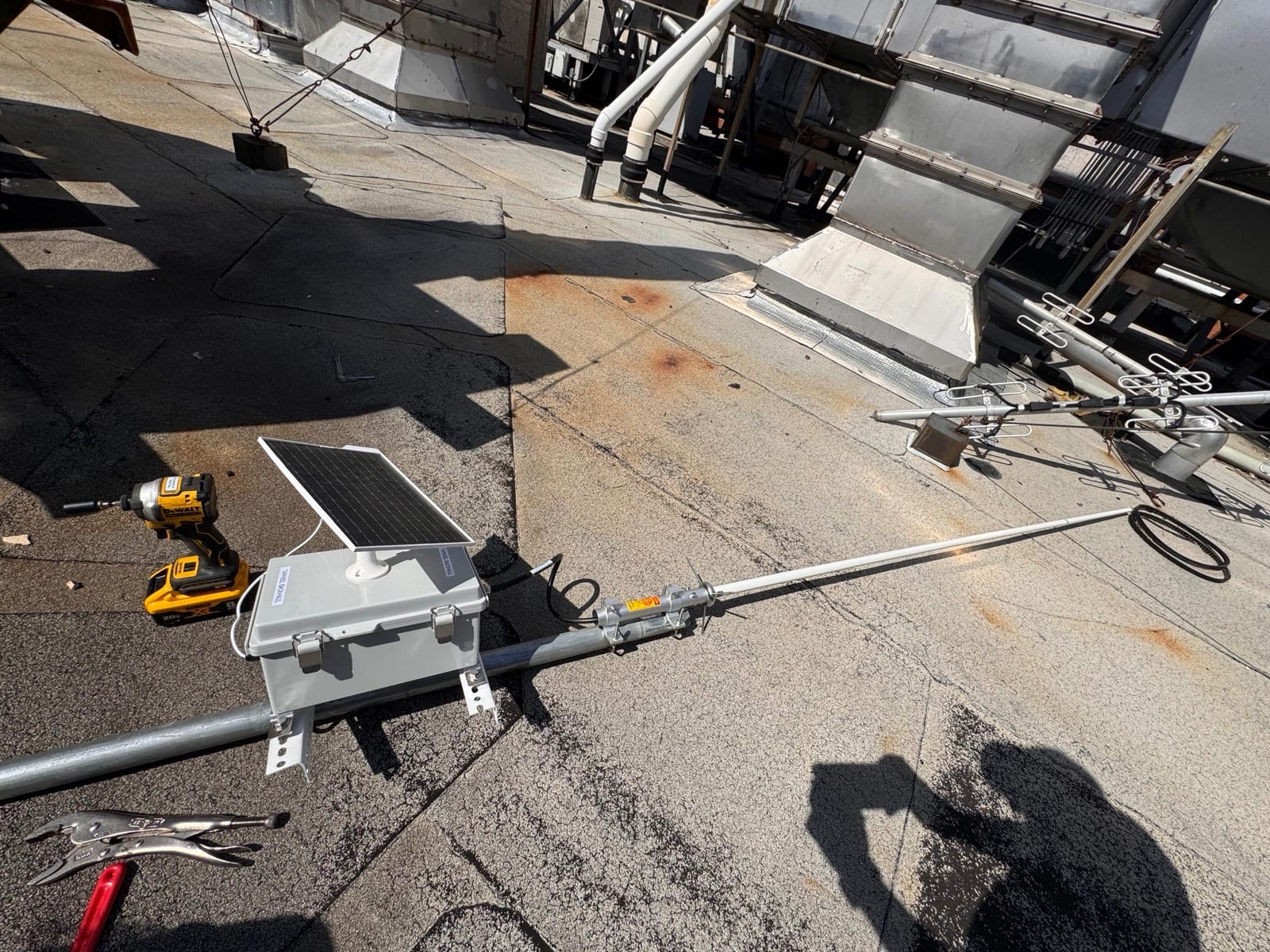
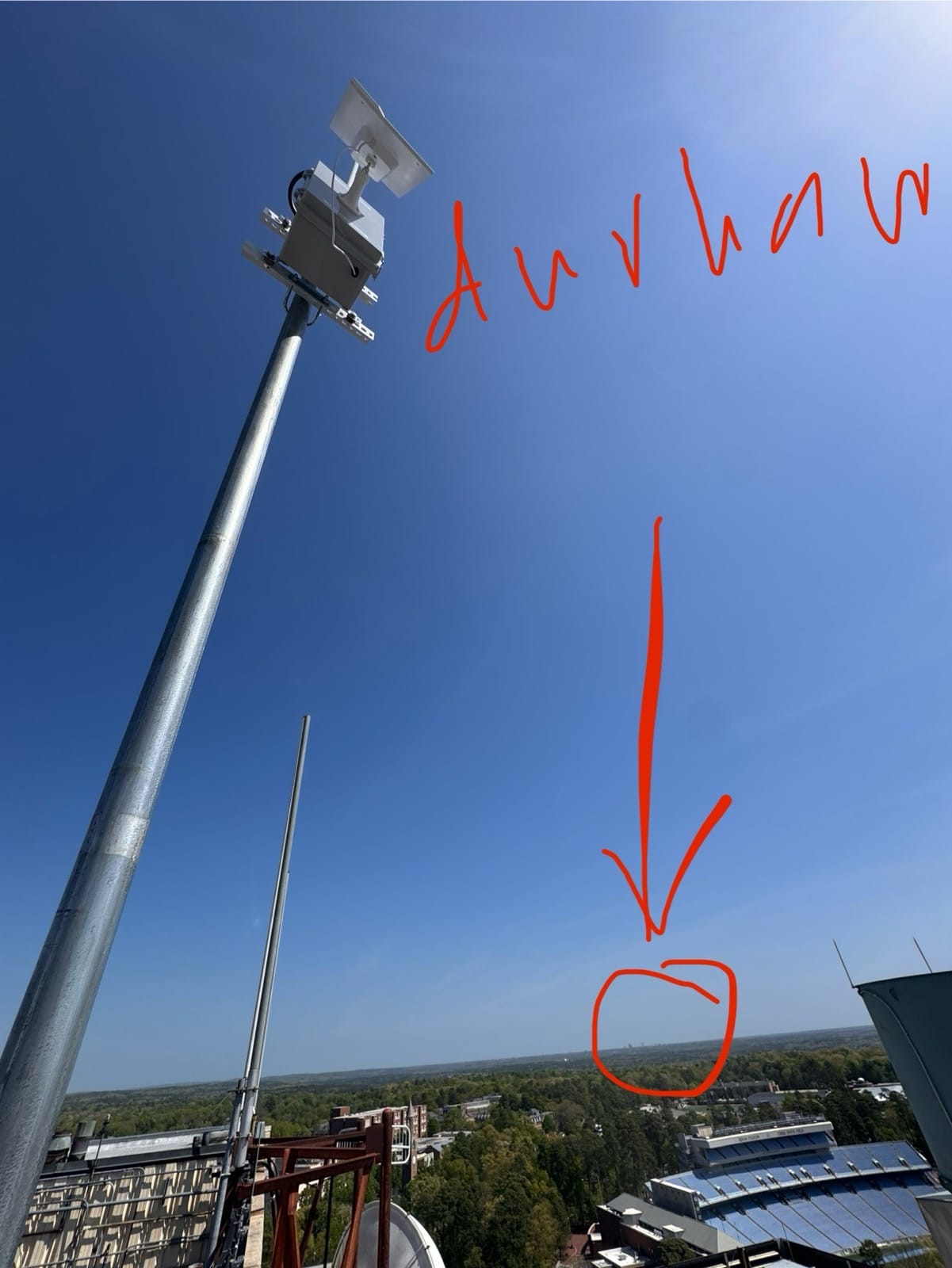
Individually, none of those pieces would have done much – they’re just parts. Together, they became community infrastructure.
When It Came Online
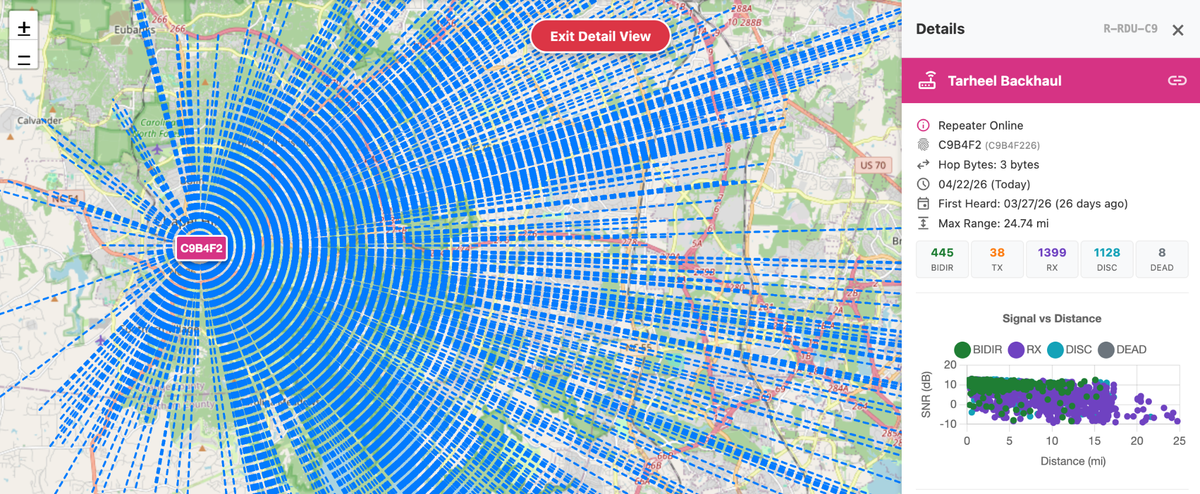
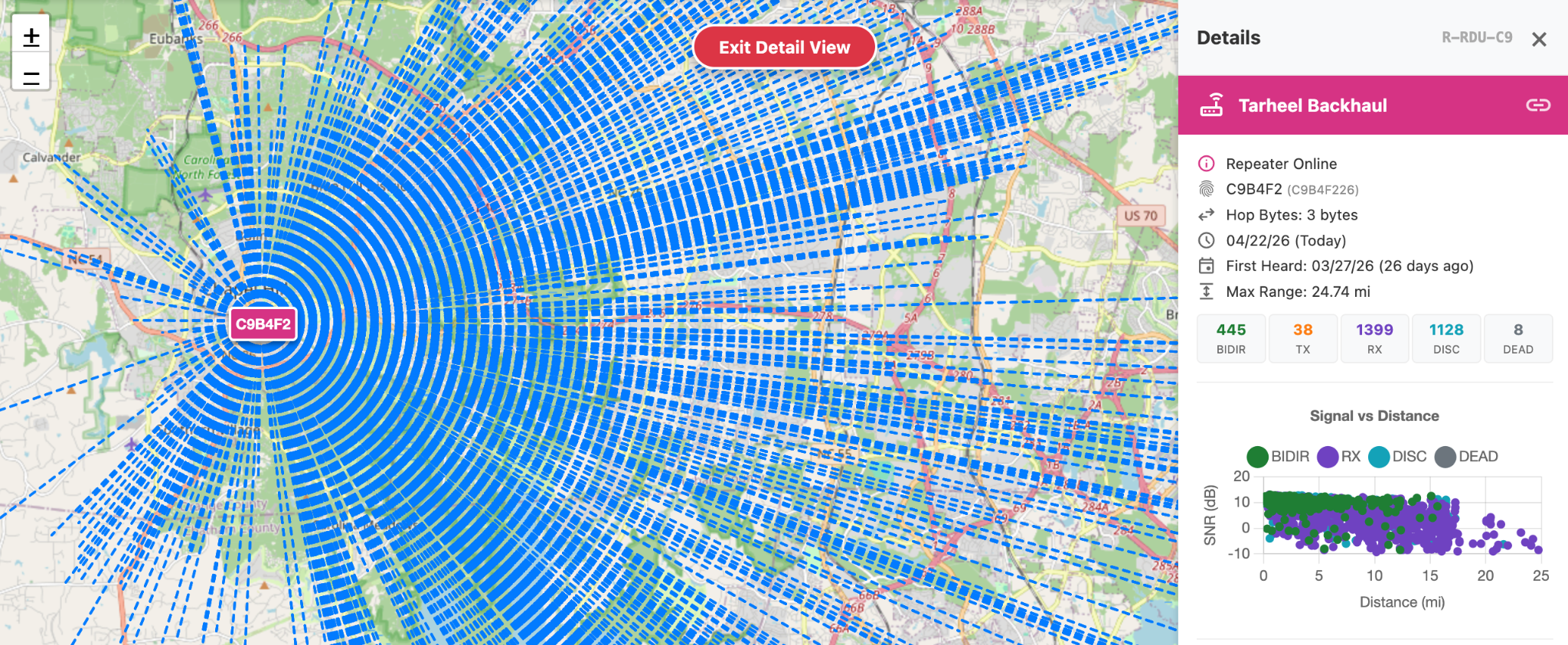
There’s no dramatic moment when a node comes online. You don’t throw a switch and watch the horizon light up. It’s quieter than that. On discord, lbibass shared a hop path with a map layer behind it. Other indicators started to show as well.
At first, the impact was local. Chapel Hill stopped feeling like the edge of the network and started behaving like a real part of it. Paths appeared where there weren’t paths before, and nodes that used to sit just out of reach (“islands”) suddenly had somewhere to go.
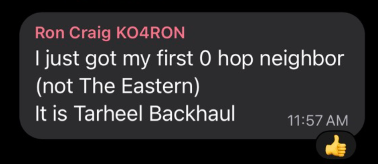
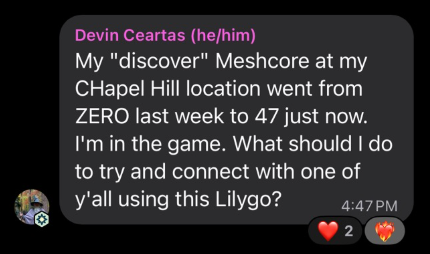
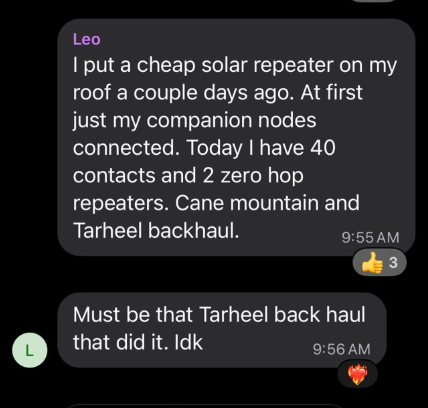
And then, after a little while, something else started to show up. Paths that weren’t the original goal. A clean, stable hop to the west – particularly to Cane Mountain in Alamance County. One link becomes another, and another after that, and before long it’s clear that what came online wasn’t just a way to connect Chapel Hill to Durham or Raleigh — it was a path reaching out toward western North Carolina, and beyond that into Tennessee, Kentucky, Georgia, Virginia.
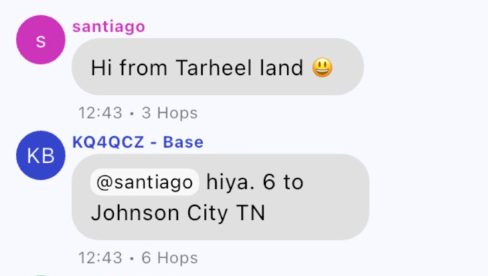
That wasn’t the headline going into it, but it’s one of the most important things that came out of it. Because at that point, we weren’t just talking about local coverage anymore. We’re talking about regions. We’re talking about the ability for information to move across distance without depending on the same centralized systems that tend to fail in the same ways, at the same times. We’re talking about a different kind of resilience.
Mutual Aid as Infrastructure
A lot of the time, mutual aid is framed around response, showing up when something breaks, filling a gap, meeting a need in the moment.
But there’s another layer to it that doesn’t get talked about as much. It’s the work of building things ahead of time, in ways that make those moments less fragile when they come. I think that’s what this is. Tarheel Backhaul isn’t just a repeater on a tall building. It’s part of a communications system that doesn’t depend on a monthly bill, doesn’t require permission to use, and doesn’t disappear just because a centralized network is overloaded or censored or unavailable. And now it’s part of a path that connects not just neighborhoods or cities, but regions. It exists because people built it, and it works because people keep participating in it.
That’s a different model of infrastructure, one that’s based on relationships instead of transactions.
Closing
That meeting in January could have just been yet another tech meet-up. Instead, it became the starting point for something that now stretches across cities, across regions, across state lines. The rooftop in Chapel Hill is part of that story, but it isn’t the whole thing. The whole thing is that people showed up, and then kept showing up, and kept building, and kept connecting what they had to what other people had already put in place. There wasn’t a single moment where it all came together. But somewhere along the way, it did. And now Chapel Hill is on the mesh.