Your Pine Trees Are Not a Conspiracy: What We Actually Know About 915 MHz and Pine Needles
Pine needles don't resonate at 915 MHz. They don't have to. Here's the actual science of what our most recognizable foliage does to mesh signals, and what to do about it.

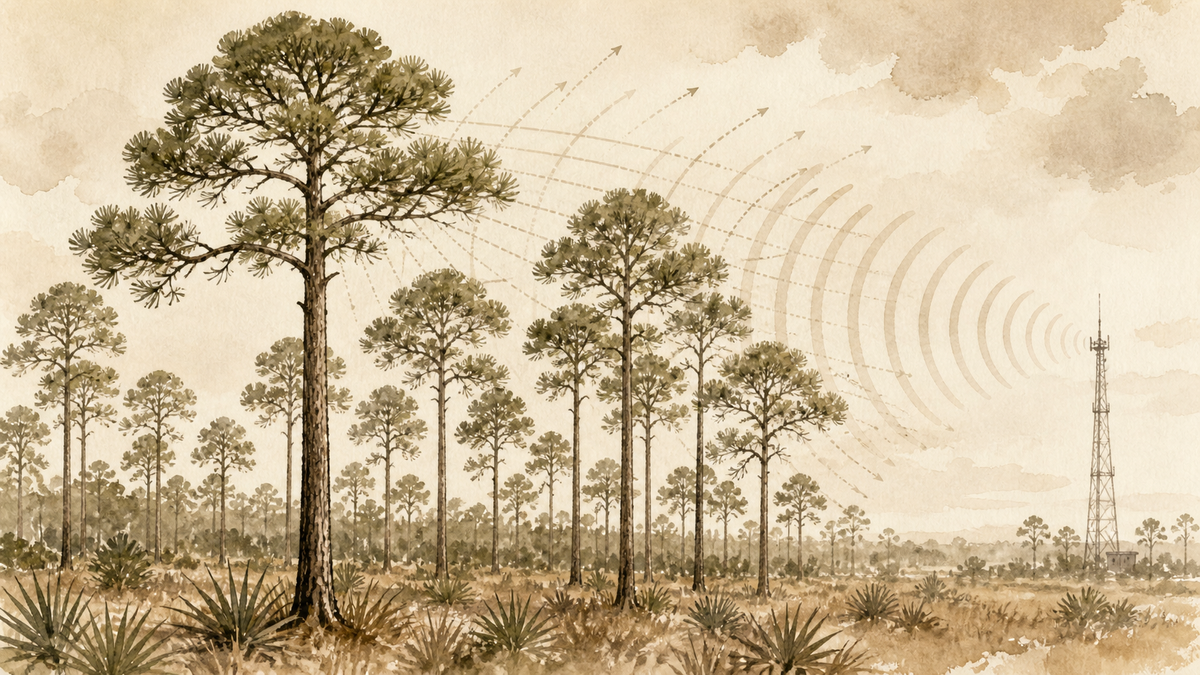
If you've spent any time in mesh networking circles, you've heard some version of it. Pine needles are quarter-wave antennas at 915 MHz. They resonate. They're tuned to kill your LoRa signal. The trees are out to get you.
It's a great story. It has just enough physics to sound plausible: at 915 MHz, a quarter wavelength works out to about 8.2 centimeters, and pine needles in the 5 to 15 centimeter range fall right in that neighborhood. The math lines up. The narrative writes itself.
The trouble is, it's not supported by a single peer-reviewed paper. Not one.
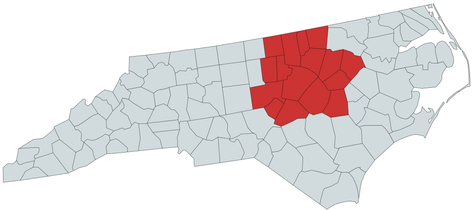
That doesn't mean pine forests don't hurt 915 MHz signals. They absolutely do. They just do it through boring, well-understood physics rather than through some malevolent botanical antenna array. And for RDUMesh, which is deploying a community mesh network across sixteen counties of pine-rich North Carolina Piedmont, understanding the difference between the folklore and the physics matters. It matters for where we put repeaters. It matters for whether the link you spent an afternoon tuning still works after a summer thunderstorm.
What's Actually Happening
Here's the unexciting truth. Pine needles attenuate radio signals through three mechanisms, and none of them involve resonance.
Water is the big one. Pine needles are 50 to 60 percent water by weight during the growing season, and water absorbs RF energy. Same principle that makes your microwave oven work at 2.45 GHz. More water in the signal path means more loss. A 2021 study in the Journal of Electromagnetic Analysis and Applications found that effective water path through vegetation explained 89 percent of the variance in measured RF loss at 2.4 GHz. The water content of the needles, not their length, is the dominant variable. If you want to predict whether a pine stand will clobber your signal, look at whether it rained yesterday.
Then there's scattering. Pine needles grow in dense fascicles of three, arranged in a matrix so thick it'd make a phased-array engineer wince. A signal traversing a pine canopy doesn't gracefully pass through one needle. It encounters hundreds, and each one scatters a fraction of the energy in some random direction. What reaches the receiver is whatever survived the statistical gauntlet.
And finally, there's diffraction around the canopy. Once you're deeper than about 14 meters into a forest, most of the signal that reaches the receiver didn't go through the trees at all. It went around them, bending over the top of the canopy. This is knife-edge diffraction, and it's why attenuation doesn't increase linearly forever. It's also why getting your antenna above the treeline beats any power amplifier you can legally run.
The Numbers for 915 MHz
The standard model for vegetation attenuation is the Weissberger Modified Exponential Decay model, built in 1982 from field measurements across frequencies from 230 MHz to 95 GHz. For 915 MHz through pine forest, here's what it predicts:
| Forest Depth | Attenuation | What That Looks Like |
|---|---|---|
| 10 meters | 4.4 dB | A tree line between adjacent properties |
| 30 meters | 9.6 dB | A modest woodlot or tree-lined suburban block |
| 100 meters | ~18 dB | A serious forest path |
Those are conservative numbers for mixed forest. Dense pure-pine stands run higher. The ITU-R P.833-10 international standard explicitly calls out dense coniferous forests as the highest-loss vegetation class at every measured frequency.
And there's a catch. Those numbers assume dry needles. In North Carolina, afternoon thunderstorms are a summer fact of life. Morning dew is routine. Wet foliage adds 3 to 8 dB on top of the dry baseline. A link that works fine on a dry February morning can fail silently on a humid July afternoon. Nothing broke. The trees got wet.
Loblolly vs. Longleaf: Know Your Pines
Not all pines are equal, and in our service area the distinction matters.
Loblolly pine (Pinus taeda) is the default. It's the second most common tree species in the United States. Needles are 6 to 9 inches long, three to a bundle. It grows fast, and by fast I mean a clear path today can have 20-foot trees in five years. In Wake, Durham, Orange, and most of our eastern and northern expansion counties, loblolly is what you're looking at.
Longleaf pine (Pinus palustris) is the wildcard. Its needles run 8 to 18 inches, roughly twice the length of loblolly, and mature trees develop crowns so dense they look like they're trying to blot out the sky. Longleaf once covered 90 million acres of the Southeast. It's been reduced to about 3 million, concentrated in preserves and restoration areas. In our service territory, longleaf becomes a factor in the Sandhills transition zone: Harnett, Lee, and the southern reaches of Johnston County. If you're deploying there and the needles are longer than your open hand, you're in longleaf country. Budget an extra 2 to 5 dB of margin.
Most of the RDUMesh footprint sits squarely in loblolly territory. The Triangle core (Wake, Durham, Orange) plus the northern Piedmont counties (Person, Granville, Vance, Warren, Franklin) are solid loblolly. Chatham, Edgecombe, Nash, Wayne, and Wilson are mostly loblolly with mixed hardwood components. The seasonal effect in those mixed areas is worth knowing: summer attenuation runs at full strength (pine needles plus broad leaves), while winter drops 20 to 30 percent as the hardwood component goes bare and pine needle water content decreases.
Get Above the Trees
The single most effective thing you can do for a 915 MHz link in pine country is also the simplest: get the antenna above the canopy.
This isn't primarily about through-foliage loss. It's about the Fresnel zone, an invisible football-shaped volume around the line-of-sight path that has to be clear of obstructions for the link to work properly. At 915 MHz with a 1.7-mile path, the first Fresnel zone has a 50-foot radius. Mount your antenna at 20 feet among 50-foot pines, and the entire Fresnel zone is blocked. The signal isn't just going through trees. It's being absorbed by the ground before it reaches the first branch.
Raise that same antenna to 60 feet (10 feet above a typical loblolly canopy) and the Fresnel zone clears. The signal propagates in clean air above the trees. Same radio, same power, same frequency, and you've recovered more dB than any amplifier at legal limits could give you.
For nodes where above-canopy mounting isn't possible (ground-level solar nodes, trail-side repeaters, portable deployments), budget realistically. A 10 to 15 dB vegetation margin for 915 MHz through NC pine forest is the consensus from field practitioners and deployment experience. If your link budget doesn't have that margin, the trees will decide whether your link works. They will not negotiate.
The Rumor, Revisited
So is the quarter-wave resonance story wrong?
At 915 MHz, λ/4 is 8.2 centimeters. Pine needles in the 5 to 15 centimeter range fall within a factor of two of that length. The geometry is real. Dielectric resonance in biological structures at microwave frequencies does happen; it's been measured in leaves, stalks, and wood at various frequencies. The claim isn't physically absurd.
But no controlled study has demonstrated resonant absorption in pine needles specifically. The standard models that practitioners use to design actual links don't include resonant terms. They don't need to. The bulk water-absorption and scattering models explain the observed loss just fine, without invoking any tuned-element physics.
Treat the resonance story the way you'd treat a colorful piece of local knowledge. It points at something real. It's just not the explanation you'd put in an engineering report.
What You Can Do Right Now
Get above the trees if you can. Every foot above the canopy is worth more than any hardware upgrade. If your site has a structure that clears the treeline (a rooftop, a water tower, a silo), that's your mount point.
If you can't get above the trees, measure the forest depth. Not the distance between antennas. The actual tree-covered distance along the signal path. Google Earth gets you close; a site visit gets you closer. For dense loblolly at 915 MHz, 0.3 dB per meter is a workable planning number.
Identify your pine species. Lobolly is the default. If the needles are longer than your open hand, you're probably in longleaf territory, especially in Harnett and Lee counties. Add 2 to 5 dB to your link budget.
Account for wet weather. If you test links in dry winter conditions and they're marginal, assume summer performance will be 5 to 8 dB worse. Test in July if you want worst-case numbers. Test in January if you want to feel optimistic for a few months.
Validate with actual measurements. The MeshMapper platform turns volunteer wardriving into coverage ground truth. Modeled attenuation is a hypothesis. Wardrived signal strength is the measurement. If you've got a node deployed, contribute your coverage data. It makes the next person's model better than yours.
The Umstead Problem
If you've spent time in the RDUMesh community, you've heard the question. Someone hikes the Loblolly Trail at Umstead, pulls out a node, and gets nothing. Or they place a repeater near the park boundary and can't reach anyone inside. The question is always some version of: "Why can't we get mesh coverage inside Umstead State Park?"
The answer is uncomfortable, and it's worth being direct about it.
William B. Umstead State Park is 5,599 acres of continuous forest wedged between Raleigh, Cary, and Durham. It's an oak-hickory-pine forest, and the pine component is overwhelmingly loblolly. The Umstead Coalition identifies only three pine species in the park; loblolly makes up "the lion's share." There is a trail system with over 34 miles of hiking paths. One of them is literally called the Loblolly Trail.
The terrain is hilly, with an average elevation around 380 feet. It's not mountainous, but it's not flat either. There are ridges, creek valleys, and three manmade lakes. Cell service already gets spotty deep in the park. Now add what we know about 915 MHz through loblolly forest.
Take a hiker standing in the middle of Umstead with a handheld LoRa node. They're surrounded by 50 to 80 foot loblolly pines in every direction. The nearest park boundary is at least half a mile away. That means the signal has to traverse somewhere between 100 and 500 meters of continuous forest before it reaches open air, depending on which direction it's heading. At 100 meters, we're already looking at roughly 18 dB of vegetation loss with dry needles. At 500 meters through wet summer foliage, you could be north of 40 dB. That's the difference between a link and radio silence.
And that's just the through-foliage loss. With hilly terrain and a handheld antenna at maybe six feet above ground, the Fresnel zone is completely obstructed. Most of the signal energy never reaches the trees; it's absorbed by the ground within the first few hundred feet.
This isn't a failure of hardware. It's not a problem you can solve with a better antenna or higher transmit power. It's geometry and physics. A 5,600-acre forest with 80-foot trees in every direction is, from a 915 MHz perspective, a very large and very effective attenuator.
Could you cover Umstead with mesh? Maybe, but not from ground level. You would need above-canopy infrastructure: a repeater on a tower that clears the treeline, or a node mounted on one of the park's higher ridge points with an antenna mast extending above the pines. From above the canopy, the signal propagates cleanly and the Fresnel zone clears. From below, you're trying to shout through a wall of wet pine needles, and the wall is winning.
This same logic applies to any large forested area in our service territory. Umstead is the most extreme example because it's the biggest contiguous block of forest in the Triangle core, but the principle is the same whether you're dealing with a 500-acre woodlot in Johnston County or a 50-acre pine plantation in Granville. If the forest is deep enough and the antenna isn't above the trees, the physics will have the final word.
The pine trees aren't going anywhere. They were here before the mesh, and they'll be here after we swap hardware three more times. The question isn't whether they affect our signals. They do. The question is whether we account for them in our planning.