Why the Heltec V4.3 Changes the Solar Repeater Math
If you're planning a solar repeater build for the RDUMesh network, the Heltec V4.3 with EasySkyMesh firmware should be near the top of your list.

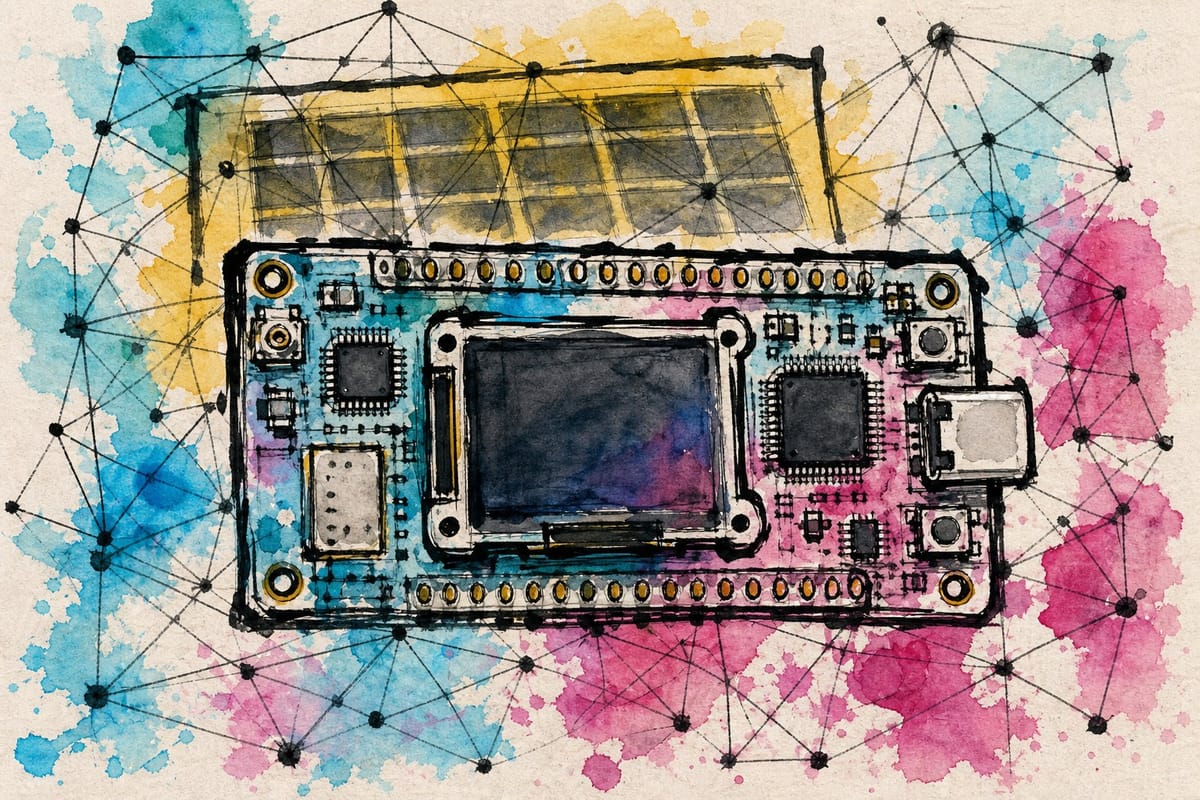
The Heltec V4 has been a frustrating board in exactly one way. It puts out 28 dBm on LoRa, has 16 MB of flash, 2 MB of PSRAM, a solar input, a GPS connector, and costs about $25. On paper it's the obvious choice for a high-power solar repeater. In practice it drew way too much power to run off a small panel and battery indefinitely.
Stock MeshCore on a Heltec V4 idles around 50 mA or more. At that draw a 3000 mAh battery gives you about 2.5 days. Add a 5W panel and you might break even on a good day, but you're not building infrastructure you can trust.
That's changing. Two things came together in early 2026 and the result is a board that can now idle at 5.5 mA while staying online as a repeater. That's the difference between a hobby experiment and something you can put on a roof and walk away from.
What the V4.3 Changed
The Heltec V4 went through several hardware revisions. The V4.0 and V4.2 used a GC1109 front-end module. The V4.3 swapped that for a KCT8103L. On the surface that's just a component change. The practical difference is that the KCT8103L lets the firmware control whether the RX signal goes through the external LNA or bypasses it.
If that sounds like a small detail, look at the numbers. With the FEM LNA enabled, the board idles around 13 mA with power saving on. With the FEM LNA disabled, that drops to about 5.8 mA. Turn off the internal chip LNA too and you get to 5.5 mA. These numbers come from EasySkyMesh PowerSaving14.1, which added the CLI controls to make it possible.
That 7.8 mA savings from disabling the FEM LNA is more than the entire idle draw of a RAK4631.
The V4.2 boards can't do this. The GC1109 doesn't support software LNA control. You have to buy the V4.3 or V4.3.1 to get the KCT8103L. If you have been sitting on a pile of V4.2 boards for a solar build, this is your reason to upgrade.
The Firmware Side
Hardware only gets you halfway. The EasySkyMesh firmware fork by IoTThinks is what actually exposes this control. It's a MeshCore fork tuned for power efficiency, and it's been iterating fast through 2026.
The relevant releases are PowerSaving14.1 (March 2026) and PowerSaving15 (April 2026). PS14.1 added Heltec V4.3 support with auto-detection of V4.2 versus V4.3 hardware, plus the CLI commands to control the FEM LNA. PS15 extended power saving to ESP32 BLE Companions, dropping them from 120 mA to 18-25 mA depending on the board.
The headline numbers don't tell the whole story. A lot of the savings come from fixes you wouldn't think to look for. The OLED was a big one. Stock MeshCore left it powered during sleep even with nothing on the screen, drawing a flat 26 mA for nothing. IoTThinks cut that entirely; it went upstream as MeshCore PR #1569. Time drift was another problem they had to solve. When an ESP32 goes into deep sleep its internal clock drifts, and early power-saving builds lost about 5 minutes per day. By PS15 they had a calibration loop that wakes the chip every 30 seconds to stabilize the clock, keeping drift under 7 seconds per day. For a solar node that might not get a GPS time sync for weeks, that actually matters.
The commands are straightforward. Connect via the CLI and run:
powersaving on
That's it for basic power saving. It persists across reboots and kicks in two minutes after boot. For the FEM LNA control on a V4.3:
set radio.fem.rxgain off
This disables the external LNA and saves that 7.8 mA. If you have a dense urban mesh with close nodes you probably won't notice the difference in receive performance. If you're building a long-range link you can leave it on and still get 13 mA, which is not bad either.
There is also a diagnostics command:
powerlog
It shows the last reset reason, shutdown reason, and boot voltage. Really useful for debugging solar nodes that brown out overnight.
What 5.5 mA Actually Means
Let's do the math. A 3000 mAh lithium battery at 5.5 mA idle gives you about 22 days of runtime with no charging at all. Add a 5W solar panel in the NC Piedmont and you're looking at indefinite uptime under normal conditions. Community testing bears this out. Multiple operators report Heltec V4.3 nodes on 5W panels with 3000 mAh batteries that rarely drop below 80% even through cloudy stretches and freezing weather.
Compare that to the same board on stock firmware at 50 mA. That's 2.5 days on battery. Solar helps but you need a much bigger panel and battery to survive consecutive cloudy days. The 5.5 mA figure changes the sizing entirely. You can use a smaller, cheaper panel and a battery that fits in a standard project box.
The MeshCore nightlies as of spring 2026 include power saving enabled by default. You don't even need to run the EasySkyMesh fork if you just want the basic power saving. But the fork gives you the FEM control and the extra tooling.
The Tradeoffs
Nothing is free. Disabling the FEM LNA reduces receive sensitivity. The spec sheet numbers are not published for the KCT8103L bypass mode, but real-world use suggests the range penalty is acceptable inside about 5 km links. For longer links or fringe reception you probably want the LNA on.
There is also the ESP32-S3R2 situation. The SoC on all V4 revisions is reportedly end of life. That doesn't mean boards disappear tomorrow. It means the long term supply picture is uncertain. For a build you plan to deploy this season it's fine. For a five year hardware standard it is worth knowing.
The V4.3.1 revision (February 2026) adds SAW filter footprints on the RX chain that are not populated by default but can be fitted for 868 or 915 MHz band pass filtering. It also improves the ADC standby power and the overall grounding layout. If you're ordering new boards, get the V4.3.1.
Bottom Line
The Heltec V4 was always great on transmit power and features. The missing piece was idle current low enough for practical solar operation. The V4.3 hardware revision combined with the EasySkyMesh power saving firmware closes that gap. A 5.5 mA repeater that puts out 28 dBm for $25 is a new value proposition in the LoRa mesh hardware space.
If you're planning a solar repeater build for the RDUMesh network, the V4.3 with EasySkyMesh firmware should be near the top of your list. The hardware is available on Amazon and AliExpress. The firmware is free on GitHub. Community builds are documented on CascadiaMesh and the MeshCore forums.
Get one, flash it, throw a 5W panel and a 3000 mAh battery on it, and see what it does on the map.